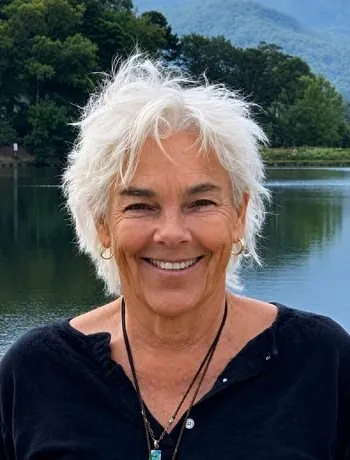
Pat Jackman, M.A., CMT, CHT, developed the Pat Jackman Method of Emotional Release Therapy. She has been guiding this work for more than thirty years and teaches the practitioner school from Sebastopol, California.
How she got here
Pat began as a counselor and social worker in 1977, and spent more than two decades in that field. It was good work and she was good at it. It also showed her its own edge: people who understood their histories in detail, who could name every pattern accurately, and who were still carrying all of it. Insight arrived, and the holding stayed where it was.
In 1995 she turned to bodywork and trained in Amanae, a hands-on modality working with connective tissue to release held emotion. That gave her the missing half — a way to reach what talking could not.
What happened over the years afterwards was not a career change but a synthesis. She kept working her own inner child material, and kept noticing what the two halves did to each other: the bodywork got somewhere the counseling could not, and the inner child work gave the bodywork somewhere to go. What emerged was different enough from what she had been taught to need its own name.
Emotional Release Therapy is that modality. The doorways came from her bodywork training; the inner child process came from everything before it; and she teaches them as one practice rather than two, because in her hands they never were two.
How she works
Pat's approach is intuitive rather than diagnostic. She does not analyse, and she does not tell people what their bodies mean. She listens, she feels, and she helps people meet the parts of themselves they had to abandon.
People who have been in a room with her tend to describe the same two things: that she is completely unhurried, and that nothing they do seems to alarm her. Both matter more than technique. Bodies open in front of people who are not braced for what comes out.
“Healing grows faster in safe soil, especially when tended with
love.”
— Pat Jackman
What she does now
Most of Pat's work is teaching. Through the ERT practitioner school she has trained small cohorts — never more than eight at a time — who now practice across the United States, Canada and Mexico.
She leads live-in retreats of no more than twelve people, and teaches the one-day workshop in Sebastopol.
Pat occasionally sees private clients, in person only, though most one-to-one work is now carried by her students. If you are looking for a session, the practitioner directory is the place to start.
Credentials and background
- Qualifications
- M.A. · CMT · CHT
- Counseling and social work
- Since 1977
- Emotional Release Therapy
- Practitioner and workshop leader since 1995
- Trained in
- Amanae, before developing ERT
- Based in
- Sebastopol, California
- Travels
- Worldwide, when a group forms
Where to find her
She can be reached at patjackman1@gmail.com or +1 707 478 4383 — a text or an email is the best way. If you are looking for a session rather than a class, the practitioner directory is the place to start.
Questions about Pat
Did Pat invent Emotional Release Therapy?
She developed it, which is the more accurate word. She trained in Amanae in 1995 and evolved it through her own inner child work into a distinct modality with its own name, its own map of points, and its own training. ERT as it is taught today is hers.
Does Pat still take private clients?
Occasionally, in person only. Most one-to-one work is now carried by her students, so the directory is the place to start if you are looking for a session.
Is Pat a licensed therapist?
She holds an M.A. and worked as a counselor and social worker from 1977. ERT is not psychotherapy and is not a substitute for it — it sits alongside that care rather than replacing it.
Does she teach outside California?
Yes. The school and the one-day workshop are taught in Sebastopol, but retreats travel — they run elsewhere when a group forms, and the next one is in Virginia. She travels internationally for the same reason. If you have a group and a space, it is worth asking.
How do I train with her?
Experience the work first — a session, the one-day workshop, or a retreat. Then register for the school. She takes eight students at a time and teaches every module herself.
Emotional Release Therapy is not a substitute for medical or psychological treatment, and does not diagnose, cure or treat any condition. Results vary from person to person.